Sterister
5cc9133b3c
`live record <link> [-o base] [--put --server URL]` writes what a channel
carries until the channel ends or Ctrl-C:
- text goes to base.txt;
- video and sound go to base.webm or base.mp4: the init, then every chunk in
  the order sent. A chunk that arrives late is left out and counted. A new
  init continues in base-2.…;
- pictures go to base-images/.

ffmpeg then rewrites each recording with -c copy, which adds an index for
seeking and starts the clock at 0:00. `--put` seals and uploads the recording
under the channel's name (several files become an album). LiveRecorder is
exported from @shade/media/node.

`live video` now sends a sticky meta frame like text and picture channels do.
The browser and Android players ignore it.

Verified against a real relay:
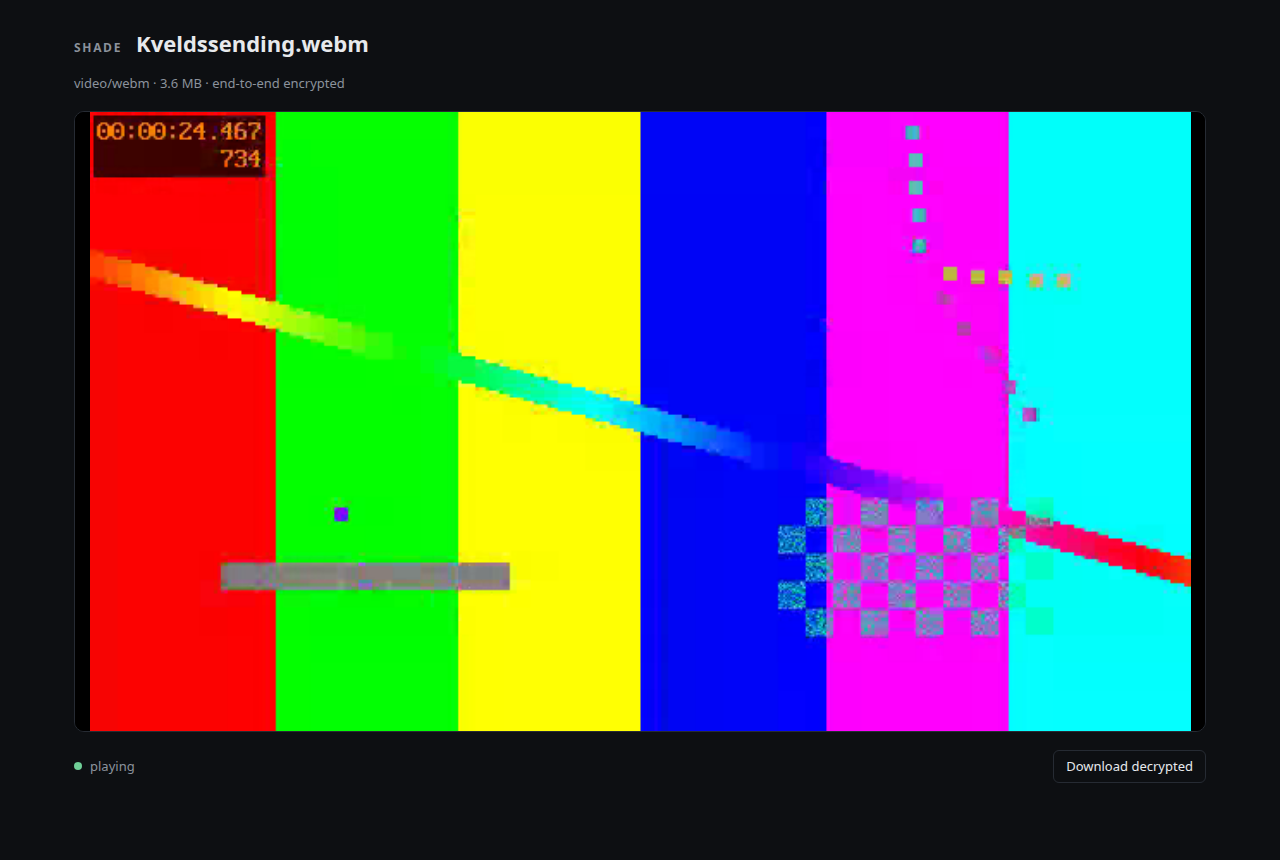
- A 30 s VP8/Opus broadcast was recorded and is 29–32 s long, starting at 0.
- It was uploaded as "Kveldssending.webm" and plays in Chromium, with a seek
  to 22 s (frame 14).
- Live playback with the meta frame still plays, with 2.4 s latency.

Tests:
- object-store's memory test now runs in its own process. RSS is process-wide,
  and other test files in the same `bun test` made it flaky (192 MiB). It now
  compares memory held after a collection at 128 MiB and 512 MiB, ~85 vs
  ~103 MiB, instead of using a magic number.
- The sweep test has its own prefix.
- tests/live-record.test.ts (4).
- media 122 green, 3 runs in a row. All 27 packages type-check.

Co-Authored-By: Claude Opus 5.5 (1M context) <noreply@anthropic.com>
165 KiB
1280x860px
165 KiB
1280x860px